
What is a real-time GPS Tracker?
Have you ever wondered how delivery companies track their trucks in real time?
Or how you could find your car if someone stole it? The answer lies in a small but powerful device: the real-time GPS tracker.
In fact, the global GPS tracking device market was valued at 2.91 billion in 2024; And experts predict it will reach about 6.55 billion by 2032.
That means more and more people are using GPS trackers to protect what matters most.
So, what exactly is a GPS tracker? How does it work?
And why should you consider using one?
Let’s break it down in simple terms.
So, What is a Real-time GPS Tracker?
A GPS tracker is a small electronic device.
It uses satellite signals to figure out its exact location.
Then, it sends that location to your phone or computer using cellular networks.
That’s it.
You log into an app or website.
And you can see where the tracker is – anytime, anywhere.
No complicated steps. No manual updates.
It just works.
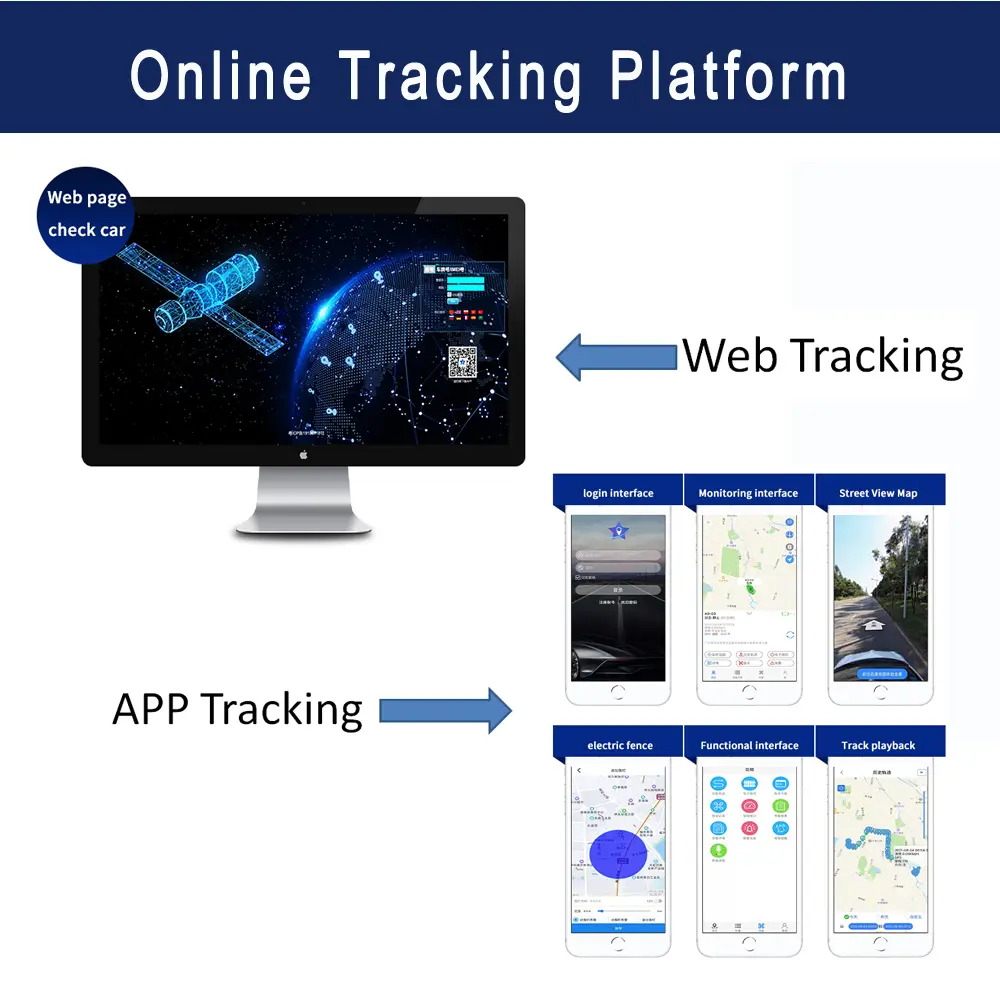
Popular Features of Real-time GPS Trackers
Modern GPS trackers do much more than just show a location.
They come with many useful features.
Here are some of the most popular ones:
- Real-Time Location Tracking – See exactly where the device is at this moment.
- History Playback – Check where the device has been over the past few days or weeks.
- Geofencing – Draw a virtual fence on a map. Get an alert when the device leaves that area.
- Speeding Alerts – Receive a notification if the vehicle goes too fast.
- SOS Button – In an emergency, press the button to send an instant alert with the exact location.
- Remote Engine Cut-off – For vehicles, you can stop the engine remotely if the car gets stolen.
Where Can You Use a GPS Tracker?
The applications are endless.
But here are the most common ones:
1. Vehicle Tracking & Anti-Theft
This is the biggest market.
You can hide a tracker in your car, motorcycle, or even a rental fleet.
Logistics companies use them for fleet management.
They track each truck, optimize routes, and reduce fuel costs.
For vehicle tracking, we recommend different models based on your needs:
GV305-2 Way 4G GPS Tracker & Car Alarm design for car, motorcycle and fleet.
G25-Mini GPS Tracker design for car & motorcycle.
GT02D-4G Mini Car Tracker design for car, motorcycle & fleet management.
2. Personal & Pet Safety tracking
Worried about your pets or livestock as cattle, cow and sheep?
Give them a small GPS tracker.
Attach a small pet tracker or livestock tracker to the collar.
If they runs away, you can find it fast.
3. Asset & Cargo Management
Banks use GPS trackers for cash transport trucks.
Logistics companies use them for high-value goods.
Cold chain companies track both location and temperature.
That way, medicines or fresh food stay safe during delivery.
For Asset & Cargo Management, we recommend different models based on your needs:
Wireless Asset GPS Tracker with strong magnetic & long-lasting battery model V9 & H501
Lock gps tracker design for container tracking IL002
Wireless Solar Powered GPS Tracker S9
Long Standby Solar GPS Container Tracker S7
4. GPS Tracker + Speed limiter
Speeding is a major cause of accidents.
So, many companies now use a GPS tracker with speed limiter.
How does it work?
First, the GPS tracker monitors the vehicle’s real-time speed.
If the driver goes too fast, the system sends an alert.
Then, the speed limiter kicks in.
It cuts fuel or signals the engine to slow down.
As a result, the vehicle cannot exceed the set speed limit.
This is very popular for teen driver safety.
Parents can set a maximum speed for the family car.
Similarly, delivery companies use it for fleet management.
They protect their drivers, save fuel, and avoid speeding tickets.
For Speed Limiter GPS Tracker, we recommend different models based on your needs:
Mini Vehicle Speed Limiter GV90S
Speed Limiter Fleet Management GPS Tracker ITMS Nano
GPS Tracker with Speed Limiter and Tachograph GV100S
Digital Tachograph Car Black Box Speed Limiter GPS Tracker QTM600B
how gps tracker work?
Have you ever wondered how a small GPS tracker knows exactly where you are?
Maybe you put one in your car. Or you check where your food delivery rider is.
Behind that little dot on your screen, there’s actually some amazing technology.
But don’t worry. I’ll explain it in simple words.
Let’s start with a basic math problem you already know.
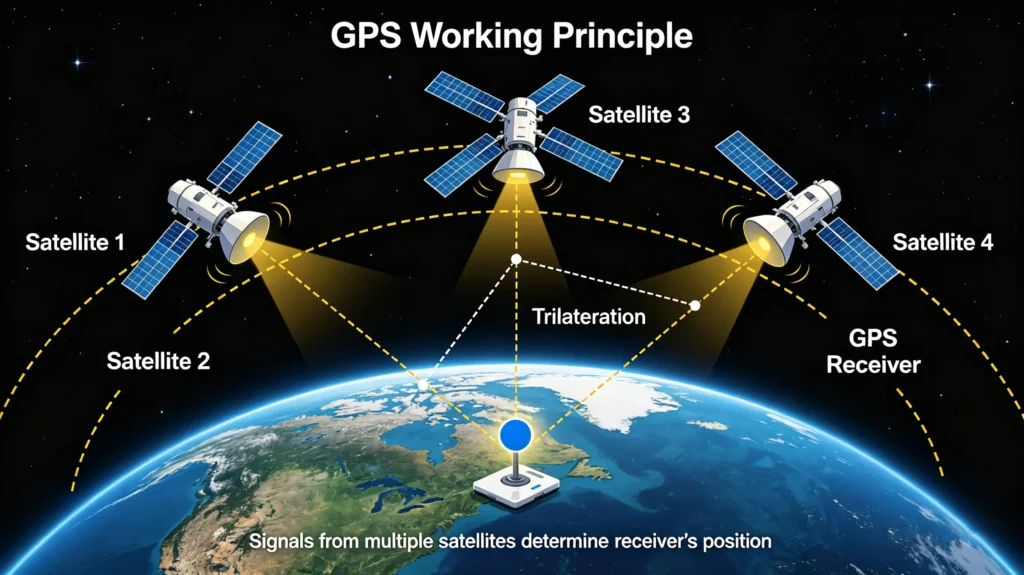
1. The Core Idea: A Simple “Circle Puzzle”
The heart of GPS tracking is actually a math idea we learn in school:
If you know your distance from three known points, you can find your exact location.
In a flat world, three circles can meet at one point.
But we live in a three-dimensional world.
So, a GPS tracker needs at least four satellites to get a precise fix.
Let me use a simple example.
Step 1:
You hear a voice say, “You are 100 meters from point A.”
Your possible location is a circle around A.
Step 2:
Another voice says, “You are 100 meters from point B.”
Now your location is one of two points where those two circles cross.
Step 3:
A third voice says, “You are 50 meters from point C.”
Now there is only one point left. That is where you are.
This is called trilateration.
2. The Inside Story: Three Key Parts of a GPS Tracker
Now let’s open up a GPS tracker and see what’s inside.
It has three main parts that work together.
Part 1: The “Ears” – GPS Module
This includes the GPS receiver and antenna.
Think of it as the tracker’s ears.
What does it do?
It listens for very weak radio signals from satellites high up in space.
Its only job is to:
- Lock onto at least four satellites
- Read two types of information:
- Ephemeris data – where each satellite should be right now
- Time data – when the signal was sent
Then, its chip calculates the latitude, longitude, altitude, and exact time of its location.
Part 2: The “Mouth” – Communication Module
This part includes a GSM/4G/5G module, a SIM card, and an antenna.
Knowing where you are is not enough.
The tracker must tell you that location.
So it acts like a small mobile phone.
It uses cellular networks to send the location data to an internet server.
This happens every few seconds or minutes.
That creates a continuous moving path on your screen.
Part 3: The Backup Brain – Memory and Battery
This part includes a flash chip and a battery.
Memory (like a black box):
What if the tracker enters an area with no cell signal?
For example, a remote mountain area.
In that case, it stores all location data in its local memory.
Then, when the signal returns, it sends all saved data back to the server.
Power:
The tracker may run on a built-in battery, a car battery, or an external power source.
3. Step by Step: How Data Travels to Your Phone
Now let’s put everything together.
Here’s what happens during one complete tracking session.
| Step | Action | Components Used |
|---|---|---|
| Capture | Scan for satellites, download data, calculate position | Satellites, GPS receiver |
| Upload | Package location and time, send via mobile network | Cellular module, SIM card |
| Process | Receive data, save to database, map it | Internet server, GIS system |
| Display | App requests data from server, shows dot on map | User app, web browser |
A Real-Life Example
Step 1 – Capture
You put a GPS tracker in your car.
It powers on.
Its GPS module starts scanning the sky.
Soon, it locks onto five satellites.
It calculates its exact coordinates: for example, 118.xxx°E, 24.xxx°N.
Step 2 – Upload
The main chip packages this coordinate with a timestamp.
Then, the communication module sends this data to your chosen server through a nearby cell tower.
Step 3 – Process
The internet server receives the data packet.
It saves it into a database.
Then, its software maps the coordinates onto a digital map.
Step 4 – Display
Now, you are sitting comfortably in your office.
You open your vehicle tracking app on your phone.
Your phone asks the server for the latest data.
The server sends it back.
Finally, a small dot representing your car appears perfectly on the map.
To send live location data, your GPS tracker uses the same cellular network as your phone. If you want to understand the basic path – from the tracker’s SIM card, to the cell tower, and finally to the internet – you can read this clear explanation: How Does Data Work on a Cell Phone? – CLRN”
4. Popular Search Terms You Might See
When you read more about GPS trackers, you may see these common words.
I’ve added them here because many people search for them online.
- Real-time tracking – seeing a location as it happens
- Live GPS tracking – another name for real-time tracking
- Vehicle tracking system – used by fleets and parents
- Asset tracking – tracking valuable items like tools or trailers
- GPS fleet management – tracking many trucks or vans at once
- Anti-theft GPS tracker – a small device to recover stolen vehicles
- Portable GPS tracker – small, battery-powered, and easy to move
- GPS logger – records location data without sending it live
- Geofencing – setting a virtual fence and getting alerts when it’s crossed
- Accuracy – how close the tracker is to the real location
These terms will help you search for exactly what you need.
5. What If There’s No GPS Signal? Backup Options of gps tracker
GPS signals are very weak.
They cannot go through thick walls, underground parking garages, or dense forests.
So what does a tracker do when it cannot see any satellites?
Don’t worry. It has backup plans.
Cell Tower Triangulation (LBS)
The technical foundation for locating a device using cell towers is often called Location-Based Service (LBS). This detailed course document from the University of Washington explains the underlying principles: [Technology LBS Full PDF – UW]
When the GPS signal is lost, smart trackers switch to LBS mode (Location-Based Service).
The idea is the same as trilateration.
But now, instead of space satellites, the tracker uses ground-based cell towers.
It measures the signal strength from three nearby towers.
Then it estimates its rough position.
How accurate is this?
Usually between 100 meters and one kilometer.
That’s much less accurate than GPS.
But it’s a lifesaver when you are indoors.
6. Why Accuracy Matters So Much for gps tracker?
Many people search for “most accurate GPS tracker” or “GPS tracker accuracy explained”.
Here’s the truth:
- A good GPS tracker can be accurate within 3 to 5 meters in open areas.
- With advanced systems like DGPS or RTK, accuracy can reach centimeters.
But keep in mind:
Tall buildings, bad weather, and thick tree cover can reduce accuracy.
So if you need high precision, choose a tracker with a multi-GNSS chip.
That means it can use not only American GPS but also other satellite systems like:
- GLONASS (Russia)
- Galileo (Europe)
- BeiDou (China)
More satellites mean better coverage and higher accuracy.
7. Why do we need four satellites for gps tracker?
That is a great question.
In space, three spheres can also meet at one point.
So why four satellites?
Because of time errors.
GPS measures distance like this:
Distance = Speed × Time
The signal travels at the speed of light (about 300,000 km per second).
To get the distance, we only need to know how long the signal took.
But here’s the problem:
Your GPS tracker has a cheap clock.
Satellites have super expensive atomic clocks.
Even a tiny time mistake becomes a huge distance error when multiplied by the speed of light.
That’s why engineers added a fourth satellite.
It helps the tracker solve for both:
- Your position (X, Y, Z)
- And the time error
So four satellites is the magic number.
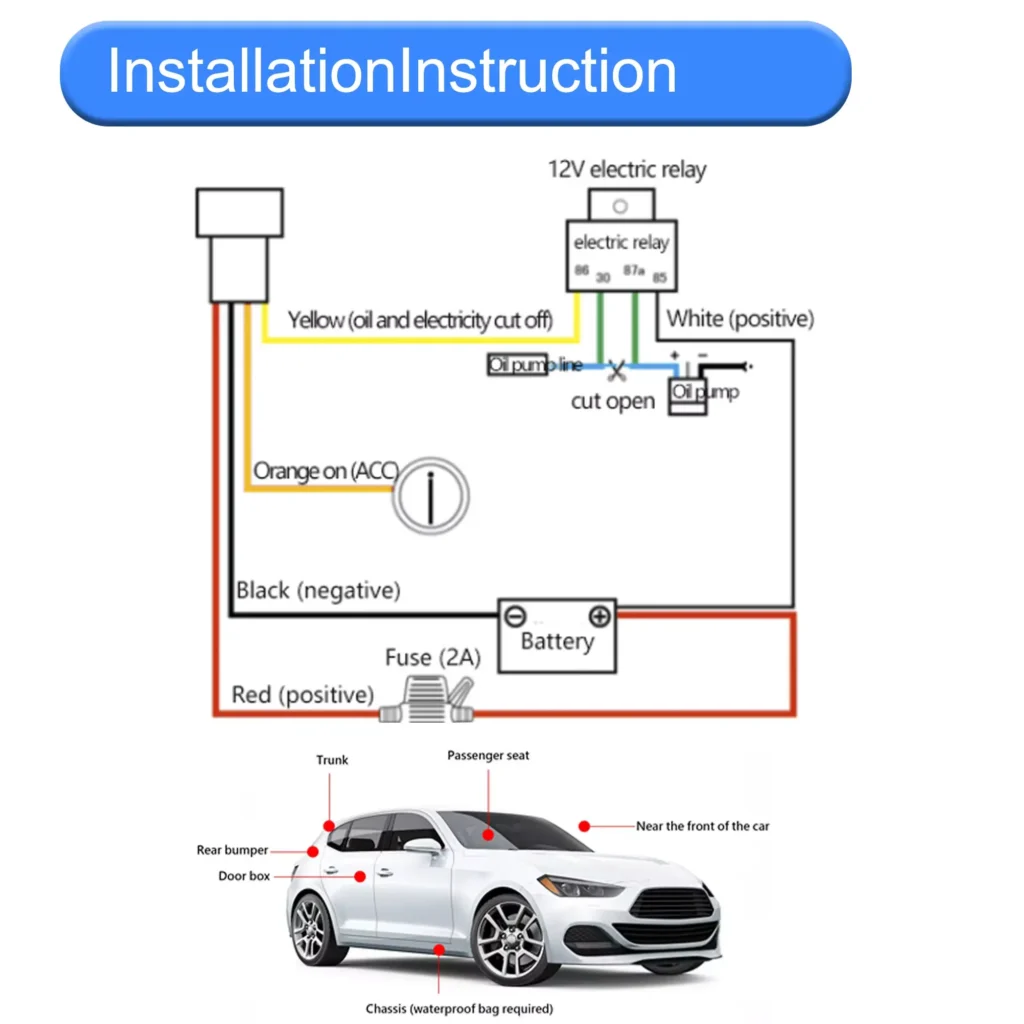
9. GPS Tracker Wiring Principles
Wiring a hardwired GPS tracker is not hard. First, you need to connect three main wires.
1. Power wire (usually red)
This wire connects to a constant power source. It gets power from the car battery all the time.
2. Ground wire (usually black)
This wire connects to the car’s metal body. It completes the circuit.
3. Ignition wire (usually white or blue)
This wire detects if the engine is on or off. This helps save battery power.
Why does this matter?
- Good wiring gives you real-time tracking without problems.
- It also prevents GPS signal interference.
- Plus, it protects your car battery from draining.
A few simple tips
- Always use a fuse on the power wire. This prevents damage from power surges.
- Keep wires away from spark plugs. That reduces signal issues.
- Test the tracker before hiding it.
Popular GPS search terms related to wiring
- Hardwired GPS tracker
- Battery protection
- Accurate GPS positioning
- GPS fleet management
- Live GPS tracking
In short
Connect power, ground, and ignition correctly. Then your GPS tracker will work well for a long time. It’s that simple.
9. Conclusion: A Beautiful Collaboration
To sum up, a simple GPS tracker is actually a wonderful mix of:
- Mathematics (trilateration)
- Physics (speed of light)
- Space technology (satellites)
- Mobile communications (cell towers)
It needs at least four satellites to solve its position and correct its clock error.
Then, it uses a cellular network to send that location to a server.
Finally, you see it as a moving dot on your phone or computer screen.
So next time you open a tracking app, remember the long journey that data took:
From a satellite’s atomic clock → through space → caught by a small antenna → processed by a smart chip → sent via a cell tower → displayed on your screen.
It’s truly a small miracle of modern technology.
And because of it, whether you are in a crowded city or on a quiet country road, you never have to feel lost again.
Hot Trends in the GPS Tracking Industry Right Now
The industry is growing fast.
And new trends are shaping its future.
Here are a few you should know about:
Multi-Satellite Support
Modern trackers don’t just use the US-based GPS.
They also use China’s BeiDou, Europe’s Galileo, and Russia’s GLONASS.
More satellites mean faster and more accurate location tracking.
This works better in dense cities or near tall buildings.
Ultra-Long Battery Life
Old trackers needed charging every few days.
Not anymore.
Some new models last up to 9 months on a single charge.
That’s perfect for hidden installations or long-term use.
Centimeter-Level Accuracy
Some advanced trackers now use RTK or PPP technology.
They can locate a device within just a few centimeters.
This is a big deal for autonomous vehicles and precision construction.
Tracking as a Service (TaaS)
Many companies no longer just sell hardware.
They offer a full subscription package.
You get the tracker, the data plan, the cloud platform, and the software features – all in one monthly fee.
That makes it easier and more affordable for businesses to get started.
Summary
So, what is a GPS tracker?
It’s a simple but powerful device.
It helps you track vehicles, protect family members, and secure valuable assets.
To sum up:
- It uses satellites to find a location.
- It sends that location to your phone or computer.
- You get real-time updates, alerts, and history reports.
- New technologies make it more accurate and battery-efficient.
Whether you want to keep an eye on your car, your child, or your cargo,
a GPS tracker offers peace of mind.
And with the market growing fast, now is a great time to try one.